


Parijata / Night Jasmine / Tree of Sorrow – Properties, Varieties, Composition & Dosages
Abstract
Nyctanthes arbor-tristis, commonly known as Parijata or Night-flowering Jasmine, is a well-known medicinal plant used in Ayurveda and folk medicine. It is praised for its wide range of therapeutic properties, including anti-inflammatory, antipyretic and anti-arthritic effects. This sacred plant also holds religious and cultural significance in India. Its leaves, flowers, seeds and bark are used for various ailments, particularly fever, joint disorders and skin conditions. Nyctanthes arbor-tristis is a small tree or large shrub belonging to the Oleaceae family. It is native to South Asia and is valued not only for its ornamental and fragrant flowers but also for its medicinal properties. The plant is also revered in Hindu mythology and often associated with divine origin stories.
Introduction
Nyctanthes arbor-tristis Linn. is a well-recognised Indian medicinal plant, widely known by its traditional name Parijat. It is considered one of the most valuable herbs in Indian traditional medicine and is currently classified as a critically endangered species in India. Belonging to the Oleaceae family, this plant holds cultural and spiritual significance, especially in regions like Maharashtra, where it is often cultivated as a sacred tree. Despite its importance, detailed pharmacognostic studies on the leaves of Nyctanthes arbor-tristis are still lacking. Traditionally, various parts of the plant, such as leaves, roots, flowers and seeds, are used in different dosage forms, such as juice and powder, to treat numerous health conditions. It is particularly effective in managing disorders associated with vitiation of Vata and Kapha doshas, according to Ayurvedic principles.
Scientific Classification
- Kingdom: Plantae
- Clade: Angiosperms
- Clade: Eudicots
- Order: Lamiales
- Family: Oleaceae
- Genus: Nyctanthes
- Species: : Nyctanthes arbor-tristis
Synonym
- Vatari – Alleviates Vata dosha
- Shuklangi – Bears white-colored flowers
- Sephalika / Shefalika – Attracts honey bees in large numbers
- Ragapushpi – Has an orange-colored flower tube
- Kharapatraka – Features coarse or rough-textured leaves
- Aparajitha / Vijaya – Symbolises victory and invincibility
- Paribhadra
- Nimbantaru
- Mandar
- Parijatak
Vernacular Names
- Hindi Name – Har Singar
- English Name – Night Jasmine / Coral Jasmine
- Bengali Name – Shefalika, Shivuli
- Gujarati Name – Harshanagar
- Kannada Name – Parijatha
- Marathi Name – Parijath
- Telugu Name – Parijatamu
- Tamil Name – Majjapu
Habitat
Nyctanthes arbor-tristis is widely found in tropical and subtropical regions of India, Nepal, and Southeast Asia. It prefers well-drained soil and thrives in sunny to semi-shaded environments. The plant is commonly grown in gardens, temple premises, and near homes due to its aromatic flowers and medicinal value.
Morphology
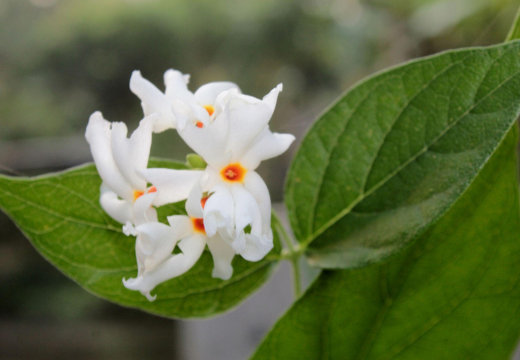
Parijatha is a large shrub or a small tree that typically grows up to 20–25 feet in height and is widely distributed across India. The leaves are coarse, with fine hairs present on their underside. The plant bears fragrant flowers featuring a white corolla with 5 to 8 lobes and a distinct orange-red tubular centre. These flowers bloom in clusters of 2 to 7 and characteristically open at dusk and wither by dawn. The fruit is a flat, heart-shaped to round brown capsule, about 2 cm in diameter, divided into two compartments, each housing a single seed. Flowering usually begins right after the monsoon, while the fruiting occurs during the spring season.
Classical Categorisation
- According to Bhavprakash Nighantu- Guduchyadi Varga
- According to Raj Nighantu- Shatahvadi varga
Ancient Verses
पारिभद्रोऽनिलश्लेष्मशोथमेदःकृमिप्रणुत् ।
तत्पत्रं पित्तरोगघ्नं कर्णव्याधिविनाशनम् ।।(Bhavprakash Nighantu Guduchyadi varga 100)
According to the above shloka, Night jasmine helps to balance Vata and Kapha dosha, inflammation and is effective in the management of worm infestation and obesity. Its leaves are used in the management of Pitta disorders and ear disorders.
Ayurvedic Properties
- Taste (Rasa)- Bitter (Tikta)
- Physical property (Guna)- Light (Laghu)
- Potency (Veerya)- Hot Potency (Usna)
- Post-digestion effect (Vipaka)- Katu (Pungent)
- Effect on tridosha- Balance Vata and Kapha dosha
Therapeutic Properties
- Hypotensive
- Antipyretic
- Laxative
- Antispasmodic
- CNS depressant
- Anti-inflammatory
- Antioxidant
- Anthelmintic (expels worms)
- Analgesic (pain-relieving)
- Hepatoprotective
- Anti-arthritic
- Immunomodulatory
- Diaphoretic (induces sweating)
Systemic actions
External- It is really effective in the management of Alopecia and contains antimicrobial properties.
Internal uses
- Nervous system- It is effective in the management of inflammation in the nervous system. It is also indicated in cases of sciatica and pain.
- Digestive system- It contains Carminative, Liver stimulant, anthelmintic, etc. properties which are effective in the management of constipation, worm infestation, low digestive fire, liver disorders and diseases related to Pitta dosha.
- Circulatory System- It is effective in Blood purification.
- Respiratory system- It helps in the management of Kapha dosha, it can be given in the management of cough, Asthma, etc.
- Reproductive System- It is indicated in Amenorrhea, Dysmenorrhea and other diseases related to the reproductive system.
- Temperature- It is really effective in the management of Chronic fever.
Chemical Composition
- Iridoid glycosides
- Mannitol
- Beta-amyrin
- Beta-sitosterol
- Hentriacontane
- Benzoic acid
- Astragalin
- Nicotiflorin
- Oleanolic acid
- Nyctanthic acid
- Friedelin
- Lupeol
- Polysaccharide glucomannan (from seeds)
Modern overview
Antihistamine Activity
The alcoholic extract of Nyctanthes arbor-tristis leaves, when dissolved in water and administered orally at doses of 4.0 and 8.0 g/kg, showed significant protection against histamine aerosol-induced asphyxia (2% at 300 mm Hg) in guinea pigs. The compounds arbortristosid A and arbortristosid C present in N. arbor-tristis have been reported to possess anti-allergic properties.
Antipyretic Activity
The extract demonstrated an antipyretic effect in rats with fever induced by brewer’s yeast. However, oral administration for six consecutive days resulted in dose-dependent gastric ulcers. The aqueous-soluble fraction of the ethanolic leaf extract showed a significant aspirin-like analgesic effect, as indicated by the inhibition of acetic acid-induced writhing in albino mice. However, it did not produce morphine-like analgesia, as confirmed by tests using the rat tail-flick and mouse tail-clip methods.
Anticancer Activity
Methanol extracts from the fruit, leaf, and stem of Nyctanthes arbor-tristis were evaluated for their in vitro anticancer activity. The dried leaf methanol extract showed moderate activity at 30 mg/ml, with 71% inhibition, while the least inhibition was noted at 10 mg/ml, despite showing 86% inhibition against pathogen-free breast cancer cell lines. A strong anticancer effect was observed against human breast cancer cell lines (MDA-MB-231) using the dried fruit methanol extract, with IC₅₀ values of 9.72 mg and 13.8 mg. The presence of glycosides, tannins, phenols, and steroids in the dried fruit extract is believed to contribute to its anticancer potential.
Practical Uses
- For Alopecia: Seed paste is applied externally to areas affected by alopecia.
- For Sciatica: Fresh leaf juice (5–10 ml) is administered orally for the treatment of sciatica.
- For Constipation, Intestinal Worms, Hepatomegaly, and Piles: Juice of the whole plant (10–15 ml) is used to treat constipation, intestinal worms, hepatomegaly, and piles.
- For Asthma and Cough: 2–3 g of dried leaf or bark powder is given with betel leaf juice.
- For Eczema and Ringworm: A paste of bark or leaves is applied externally on eczema and ringworm-affected areas.
- For Snakebite: In snakebite cases, leaf juice is given as part of the treatment protocol.
- For Painful Urination: Cold infusion of leaves is used internally to relieve painful urination.
- For Perfumes and Aromatic Products: Distilled flowers are used in making perfumes and aromatic products.
Parts Used
- Leaf
- Bark
Dosage
- Powder- 1-3 gm
- Fresh juice- 10-20 ml
- Decoction- 50-100 ml
Planet Ayurveda Medicines
Conclusion
Nyctanthes arbor-tristis (NAT) Linn, commonly known as Parijata or Harsinghar, is a highly valued traditional Indian medicinal plant. Widely utilised in Ayurveda, Siddha and Unani medicine, every part of the plant offers significant therapeutic benefits. It exhibits a broad spectrum of pharmacological activities, including anti-arthritic, antispasmodic, antibacterial, anti-inflammatory, immunostimulant, antidiabetic, hepatoprotective, antioxidant, antimicrobial, anthelmintic, antileishmanial, antipyretic, anti-allergic, antiviral and CNS depressant effects. The presence of key phytochemicals such as flavonoids, tannins, saponins, glycosides, alkaloids, steroids and phenolic compounds underpins these diverse medicinal properties, making Nyctanthes arbor-tristis an important plant for therapeutic use.