


AFP-L3 Fraction Test – What Is It? Why Is It Done? How Can Ayurvedic Herbs Help?
Abstract
Hepatocellular carcinoma (HCC) is the most common primary liver malignancy and typically develops in patients with chronic liver disease such as cirrhosis, chronic hepatitis B, chronic hepatitis C, and metabolic liver disorders. Early detection remains challenging because clinical symptoms appear late and conventional tumor markers lack adequate specificity. Alpha-fetoprotein (AFP), although widely used in liver cancer surveillance, is frequently elevated in benign hepatic conditions, limiting its diagnostic reliability.
Introduction
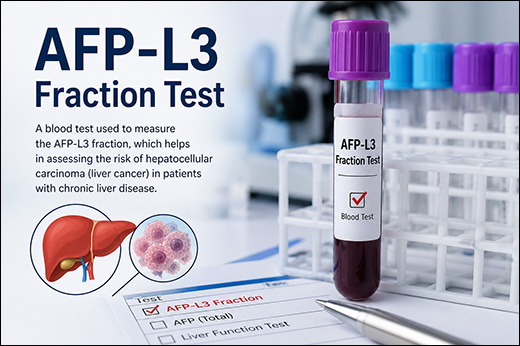
The AFP-L3 Fraction test is an advanced biomarker assay designed to improve specificity in liver cancer evaluation by identifying the malignant glycoform of AFP. By distinguishing cancer-associated AFP from benign AFP elevations, the test provides valuable information for risk stratification, early detection support, prognostic assessment, and treatment monitoring in patients at risk for hepatocellular carcinoma.
Biochemical And Molecular Basis
AFP is a fetal glycoprotein produced by hepatocytes during embryonic development. In adults, serum AFP levels are normally minimal but may increase in conditions involving hepatocyte proliferation or malignant transformation.
AFP exists in multiple glycosylated forms that differ in carbohydrate structure. These glycoforms can be separated based on their binding affinity to Lens culinaris agglutinin (LCA), a lectin that recognizes specific sugar residues. The major fractions include AFP-L1, AFP-L2, and AFP-L3. Among these, AFP-L3 is preferentially produced by malignant hepatocytes due to altered glycosylation patterns characteristic of cancer cells.
Measurement of AFP-L3 as a percentage of total AFP reflects the proportion of AFP originating from malignant tissue rather than benign liver injury.
Test Procedure And Methodology
The AFP-L3 fraction test is performed using a venous blood sample. No special patient preparation is typically required unless specified by the laboratory.
Laboratory Principle
The test combines immunoassay techniques with lectin-affinity separation to isolate AFP-L3 from total AFP based on its selective binding to Lens culinaris agglutinin.
Analytical Steps
- Blood is collected and serum is separated.
- Total AFP concentration is measured using immunoassay methods.
- AFP glycoforms are separated using lectin-binding affinity techniques.
- AFP-L3 is quantified and reported as a percentage of total AFP.
Reported Parameters
Laboratory reports typically include:
- Total AFP concentration (ng/mL)
- AFP-L3 percentage (%)
Clinical Significance
Improved Specificity For Hepatocellular Carcinoma
AFP-L3 provides greater specificity for HCC compared to total AFP alone by identifying AFP produced specifically by malignant hepatocytes.
Detection Of Early Or Small Tumors
AFP-L3 may be elevated in early-stage hepatocellular carcinoma and in patients with borderline AFP values, making it a useful adjunct marker in high-risk populations.
Risk Stratification In Chronic Liver Disease
In patients with cirrhosis or chronic viral hepatitis, rising AFP-L3 levels indicate increased probability of malignant transformation and warrant closer imaging surveillance.
Prognostic Value
Elevated AFP-L3 levels have been associated with aggressive tumor behavior, vascular invasion, and poorer survival outcomes.
Monitoring Treatment Response
Declining AFP-L3 levels following therapy suggest treatment response, whereas rising levels may indicate recurrence or progression.
Interpretation of Test Results
AFP-L3 is interpreted as a percentage of total AFP and should always be correlated with imaging and clinical context.
Low AFP-L3 Percentage
A low proportion suggests AFP elevation, if present, is more likely related to benign liver disease such as hepatitis, cirrhosis, or liver regeneration. However, normal results do not exclude early malignancy.
Elevated AFP-L3 Percentage
An increased AFP-L3 proportion indicates a higher likelihood of hepatocellular carcinoma and may suggest malignant transformation even when total AFP levels are borderline. Higher values may correlate with more aggressive tumor biology.
Risk Interpretation Framework
- Normal AFP with low AFP-L3 → routine surveillance
- Elevated AFP with low AFP-L3 → likely benign hepatic process
- Elevated AFP with high AFP-L3 → increased suspicion for HCC
- Rising AFP-L3 trend → increasing oncologic risk
AFP-L3 should not be used as a standalone diagnostic tool but rather as part of a multi-modal evaluation including imaging and clinical assessment.
Evidence From Clinical Research
Clinical research demonstrates that AFP-L3 has higher specificity for hepatocellular carcinoma compared to total AFP alone. Studies show significantly elevated AFP-L3 levels in patients with HCC relative to benign liver disease. Combined biomarker strategies using AFP-L3 with total AFP and des-gamma-carboxy prothrombin improve detection accuracy, particularly in early-stage tumors.
Meta-analyses have also shown that elevated AFP-L3 percentage is associated with poorer survival and more aggressive tumor behavior. However, sensitivity for very early HCC may be limited when AFP-L3 is used alone, reinforcing its role as an adjunct diagnostic marker.
Advantages
- Higher specificity for malignant hepatocytes
- Supports early detection strategies
- Provides prognostic information
- Non-invasive and repeatable
- Useful when AFP levels are borderline
Limitations
- Not diagnostic when used alone
- Sensitivity varies in early disease
- Requires specialized laboratory technology
- Must be interpreted with imaging studies
Role In Contemporary Hepatology
The AFP-L3 fraction test represents an important component of modern liver cancer surveillance strategies. With the global rise in chronic liver disease, non-invasive biomarker-based risk assessment has become increasingly important. AFP-L3 contributes to a precision-oriented approach by refining interpretation of AFP elevations and identifying patients requiring closer monitoring.
How Can Ayurvedic Herbs Help?
In the Ayurvedic framework, maintenance of hepatic health and metabolic balance is supported through dravyas possessing Pittashamaka (Pitta dosha balancing), Raktaprasadana (nourishing blood tissue), and Rasayana (rejuvenation) properties. Classical texts emphasize the role of Tikta (bitter) rasa dominant herbs and Yakrit-uttejaka (liver stimulant) dravyas (herbs) in preserving the functional stability of the liver, promoting proper dhatu (tissue) metabolism, and facilitating physiological detoxification processes. Such herbs are traditionally described to support cellular resilience, regulate agni (digestion power) at the dhatu (tissue) level, and maintain systemic homeostasis in conditions of chronic metabolic burden. On this basis, several well-established Ayurvedic herbs are recognized for their supportive role in maintaining hepatic tissue health and functional balance.
Bhumi Amla (Phyllanthus niruri)
Bhumi Amalaki (Phyllanthus niruri) supports hepatic cellular integrity through lignans such as phyllanthin and hypophyllanthin, along with polyphenols like ellagic acid and corilagin. These compounds enhance antioxidant defenses by activating Nrf2-mediated pathways and increasing glutathione activity, while suppressing NF-κB–driven inflammatory signaling. Experimental studies also indicate modulation of TGF-β–associated fibrogenic pathways and stabilization of hepatocyte membranes, contributing to maintenance of metabolic balance and cellular resilience under chronic hepatic stress.
Kalmegh (Andrographis paniculata)
Kalmegha contains diterpenoid lactones, chiefly andrographolide, which exhibit hepatocyte-protective and anti-inflammatory effects. It enhances antioxidant defenses via Nrf2 pathway activation, reduces oxidative injury, and suppresses NF-κB–mediated inflammatory signaling. Experimental studies indicate stabilization of hepatocellular membranes and modulation of bile secretion and metabolic enzyme activity. Kalmegha also shows regulatory influence on fibrogenic pathways, supporting maintenance of hepatic cellular homeostasis and functional resilience under conditions of chronic metabolic stress.
Sharpunkha (Tephrosia purpurea)
Sharpunkha contains flavonoids, rotenoids, and polyphenolic compounds that support hepatic cellular protection and metabolic regulation. Experimental studies indicate antioxidant activity through enhancement of glutathione-dependent pathways and reduction of lipid peroxidation. It demonstrates anti-inflammatory effects via modulation of NF-κB signaling and shows influence on bile regulation and hepatocyte membrane stability. These actions collectively support maintenance of hepatic tissue integrity and functional balance under conditions of chronic metabolic and inflammatory stress.
Bhringaraja (Eclipta alba)
Bhringaraja contains bioactive compounds such as wedelolactone, ecliptine, and flavonoids that support hepatocyte protection and cellular regeneration. Experimental studies indicate antioxidant activity through enhancement of glutathione levels and reduction of lipid peroxidation, along with suppression of NF-κB–mediated inflammatory signaling. It also demonstrates modulatory effects on hepatocellular enzyme stability and fibrogenic pathways, contributing to preservation of hepatic tissue architecture and metabolic homeostasis under chronic cellular stress.
Kutki (Picrorhiza kurroa)
Kutki contains iridoid glycosides, primarily picroside I and picroside II, which exhibit hepatocyte-protective and antioxidant properties. These compounds enhance cellular defense by activating Nrf2-mediated antioxidant pathways, reducing lipid peroxidation, and stabilizing hepatocyte membranes. Experimental studies also indicate suppression of NF-κB–driven inflammatory signaling and modulation of fibrogenic mediators such as TGF-β. Through these mechanisms, Kutki supports hepatic metabolic regulation and preservation of tissue integrity under chronic oxidative and inflammatory stress.
Punarnava (Boerhavia diffusa)
Punarnava contains bioactive constituents such as punarnavine, boeravinones, and flavonoids that support hepatic cellular protection and metabolic regulation. Experimental studies demonstrate antioxidant activity through enhancement of glutathione levels and reduction of lipid peroxidation, along with modulation of NF-κB–mediated inflammatory pathways. It also shows regulatory influence on fluid balance and microcirculatory function, contributing to maintenance of hepatic tissue homeostasis and resilience under conditions of chronic metabolic and inflammatory stress.
Conclusion
The AFP-L3 fraction test enhances the clinical value of alpha-fetoprotein by identifying the malignant glycoform associated with hepatocellular carcinoma, thereby improving specificity in patients with chronic liver disease. When integrated with imaging and clinical assessment, AFP-L3 supports earlier risk identification, refines prognostic evaluation, and assists in monitoring treatment response and disease progression. Although not diagnostic when used alone, it represents an important component of contemporary, multimodal liver cancer surveillance strategies. From an integrative perspective, maintaining hepatic cellular resilience remains essential for long-term health. Traditional hepatoprotective Ayurvedic herbs, recognized for antioxidant and metabolic regulatory properties, may provide supportive benefits in preserving liver function. Together, precise biomarker assessment and supportive hepatic care contribute to a comprehensive approach to liver health management.