


Hydrogen Breath Test – What Is It? Why Is It Done? How Can Ayurvedic Herbs Help?
Introduction
SIIBO is a microscopic "border breach" where fermenting bacteria migrate from the colon into the quiet transit zone of the small intestine. This displaced colony stages a mutiny, intercepting your nutrients to create a turbulent "internal storm" of gas and inflammation. The Hydrogen Breath Test acts as a scientific translator for this chaos. Since humans don’t produce hydrogen or methane, your exhaled breath becomes a "chemical fingerprint" of bacterial activity. By tracking these gas spikes after a sugar challenge, the test decodes the microbial rebellion, transforming invisible distress into a clear, actionable diagnostic map. Let’s study about this test in detail!
Introduction
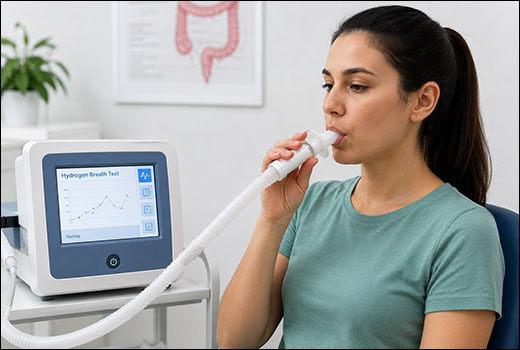
The Hydrogen Breath Test (HBT) is a non-invasive diagnostic tool used to identify common gastrointestinal conditions, such as Small Intestinal Bacterial Overgrowth (SIBO) and dietary sugar intolerances (e.g., lactose or fructose malabsorption). The test is based on the physiological fact that human cells do not produce hydrogen or methane gases; these are exclusively produced by anaerobic bacteria in the colon when they ferment undigested carbohydrates. During the procedure, a patient ingests a specific sugar solution. If the sugars are not properly absorbed in the small intestine or if excess bacteria are present, the microbes ferment the substrate, releasing gases that are absorbed into the bloodstream and eventually exhaled through the lungs. By measuring the concentration of hydrogen and methane in breath samples collected at timed intervals, clinicians can determine the location and severity of malabsorption or bacterial colonisation. It is a preferred clinical method due to its safety, simplicity, and high patient compliance compared to more invasive options like intestinal aspiration.
What Happens During The Procedure?
The Hydrogen Breath Test is a straightforward, non-invasive procedure that typically takes between 2 and 4 hours, depending on the specific condition being investigated.
- Baseline Sample: The test begins with a "baseline" breath sample. You will be asked to take a deep breath, hold it for a few seconds, and then exhale into a specialized breathalyzer or a collection bag. This establishes your starting hydrogen and methane levels.
- Ingesting the Substrate: After the baseline, you will drink a small glass of water mixed with a specific sugar (the substrate), such as lactulose, glucose, lactose, or fructose.
- Timed Breath Collection: For the next several hours, you will provide breath samples at regular intervals (usually every 15 to 20 minutes). This allows clinicians to track the "transit time" of the sugar as it moves through your digestive tract.
- Symptom Monitoring: During the collection period, you will be asked to note any gastrointestinal sensations, such as bloating, cramping, or flatulence. Correlating these symptoms with gas spikes is a key part of the diagnosis.
Indications
- Lactose Intolerance- Used to confirm inability to digest lactose due to deficiency of lactase enzymes
- Small Intestinal Bacterial Overgrowth (SIBO)- Helps detect excessive bacterial growth in the small intestine that ferments carbohydrates and produces hydrogen.
- Fructose Malabsorption- Used when patients develop bloating, gas, or diarrhea after consuming fructose-containing foods.
- Irritable Bowel Syndrome (IBS)
Sometimes used to identify underlying carbohydrate malabsorption or SIBO in patients with IBS symptoms. - Unexplained Gastrointestinal Symptoms- Such as chronic bloating, abdominal pain, excessive gas, diarrhea, or flatulence.
- Assessment of Carbohydrate Malabsorption- Can evaluate digestion of certain sugars such as lactose, fructose, or sorbitol.
- Evaluation after Intestinal Surgery or Motility Disorders- To detect bacterial overgrowth caused by altered intestinal movement.
Results Interpretation
Interpreting the Hydrogen Breath Test is like reading a "GPS map" of your digestion. The results depend on the timing and concentration of gases detected in your breath.
- The "Double Peak" Rule (SIBO)– A positive result for Small Intestinal Bacterial Overgrowth (SIBO) is typically identified by an early rise in gas levels.
- The Criteria: A rise in Hydrogen ($H_2$) of $\ge$ 20 ppm (parts per million) above the baseline within the first 90 to 120 minutes.
- The Logic: Since the sugar hasn’t reached the large intestine yet, an early spike proves that a "rebel colony" of bacteria is feasting prematurely in the small intestine.
- Methane Dominance ($CH_4$)– Methane is produced by Archaea, not just standard bacteria.
- The Criteria: A concentration of $\ge$ 10 ppm at any point during the test.
- The Insight: High methane levels are strongly correlated with constipation, as these gases physically slow down the "transit time" of your gut.
- Carbohydrate Malabsorption– If the gas spike occurs late (after 120 minutes), it indicates the sugar wasn’t absorbed in the small intestine and finally hit the “microbial metropolis” of the colon.
- Lactose/Fructose Intolerance: Confirmed if hydrogen rises $\ge$ 20 ppm over baseline after the 2-hour mark, often accompanied by clinical symptoms like bloating or urgency.
Ayurveda’s Insight!
In the Ayurvedic tradition, the clinical presentation of SIBO and the phenomena captured by a Hydrogen Breath Test align closely with the disruption of Agni (digestive fire) and the manifestation of Gulma or Grahani Roga.
The Pathophysiology Of “Microbial Mutiny”
- Mandagni (Weakened Digestion): When the central digestive fire is impaired, food is not properly transformed. This leads to the formation of Ama (metabolic toxins)—undigested material that stagnates in the small intestine (Amashaya), providing a breeding ground for what Ayurveda views as an imbalance of "Krimi" (microbes).
- Vata-Vyadhi & Samana Vayu: The gas detected in a breath test is essentially a measurable byproduct of Vata aggravation. Specifically, a disturbance in Samana Vayu (the sub-dosha governing the small intestine) causes the "upward movement" of gas (Udavarta), which clinically correlates with the hydrogen and methane measured in the breath.
Correlating The Gas Profiles
Gas Type |
Ayurvedic Correlation |
Clinical Insight |
Hydrogen ($H_2$) |
Pitta-Vata |
High fermentation and heat, leading to rapid transit (Atisara). |
Methane ($CH_4$) |
Kapha-Vata |
Heavy, stagnant qualities leading to obstruction (Vibandha). |
The Hydrogen Breath Test serves as a modern objective marker for Sama (with toxins) vs. Nirama (without toxins) states of the digestive tract, confirming when the “microbial metropolis” has breached its natural boundaries.
Ayurveda Herbs That Supports Good Gut Health
1. Vidanga (Embelia ribes)
Traditionally classified as the ultimate Krimighna (parasite/microbe destroyer), Vidanga is used to "scrape" toxins (Ama) from the intestinal walls. It possesses Deepana (digestive-kindling) properties that prevent the recurrence of fermentation. From a scientific perspective, its active principle, Embelin, exhibits significant antibacterial and anti-inflammatory properties. It interferes with the quorum sensing of pathogenic bacteria—the chemical communication they use to colonize the small intestine—effectively disrupting the "microbial mutiny" and supporting the restoration of a healthy mucosal barrier.
2. Shunti (Ginger – Zingiber officinale)
Ayurveda calls Shunti the "Universal Medicine" (Vishwabheshaja) for its ability to balance Agni without aggravating Pitta. It facilitates Anulomana (downward movement of Vata), preventing the upward reflux of gases. Scientifically, ginger functions as a powerful Prokinetic. It stimulates the Migrating Motor Complex (MMC), the "interstitial housekeeper" of the gut that sweeps undigested food and bacteria out of the small intestine during fasting phases. By enhancing gastric emptying and bile flow, it ensures carbohydrates are absorbed before bacteria can ferment them into hydrogen.
3. Musta (Cyperus rotundus)
Musta is celebrated in Ayurveda as the best Deepana-Pachana (appetizer and digestive) and Sangrahi (absorbent) herb. It is unique because it is Shita (cooling) yet effectively kindles Agni, making it ideal for Pitta-dominant individuals with fermentation issues. It "scrapes" the intestinal lining of Ama (toxic metabolic waste) that fuels bacterial overgrowth. Scientifically, Musta contains essential oils like cyperene and alpha-cyperone, which possess significant anti-spasmodic and antimicrobial properties. It modulates intestinal motility, ensuring that food moves at a healthy pace, preventing the stagnation and subsequent gas spikes measured during a breath test.
4. Haridra (Turmeric – Curcuma longa)
Haridra is utilized in Ayurveda for its Vishagna (anti-toxic) and Lekhana (scraping) qualities, which help thin out excess Kapha (mucus) that protects bacterial biofilms. It purifies the Amashaya (stomach/upper gut). Modern science focuses on Curcumin, which modulates the gut-brain axis and reduces intestinal permeability ("leaky gut"). By suppressing inflammatory cytokines like TNF-alpha, Haridra stabilizes the gut lining, making the environment less hospitable for overgrowth and reducing the systemic inflammation often associated with positive breath test results.
5. Lashuna (Garlic – Allium sativum)
In Ayurveda, Lashuna is revered as Ushna (hot) and Vata-Hara, making it a premier choice for clearing stagnation and "Vata-gases." It is specifically used to address Gulma (abdominal masses/bloating). Scientifically, Lashuna contains Allicin, a potent organosulfur compound with broad-spectrum antimicrobial activity. Modern research highlights its unique ability to inhibit Methanogenesis by targeting the lipid cell membranes of Archaea. This makes it particularly effective for "Methane-Dominant" SIBO, where it acts as a natural prokinetic to reduce intestinal transit time and alleviate chronic constipation.
6. Kutaj (Holarrhena antidysenterica)
In Ayurveda, Kutaj is the premier Arshoghna and Kandughna herb, specifically indicated for Grahani (malabsorption disorders) and Atisara (diarrhea). It possesses a powerful Stambhana (astringent) quality that dries up excess Kledaka Kapha (moisture) in the small intestine, which otherwise provides a damp breeding ground for displaced colonic microbes. From a scientific perspective, the alkaloid Conessine in Kutaj acts as a potent antimicrobial against a broad spectrum of enteric pathogens. It effectively inhibits the "Microbial Mutiny" by disrupting bacterial cell walls, making it an essential botanical for "Hydrogen-Dominant" SIBO where rapid transit and loose stools are the primary clinical features.
7. Bilva (Aegle marmelos)
In Ayurveda, Bilva is considered one of the most sacred and potent Grahi (absorbent) herbs, specifically indicated for Grahani Roga (malabsorption syndrome). It possesses a unique Deepana-Pachana (digestive-kindling) action that dries up excess Ama and dampness in the intestinal tract without causing systemic heat. Its Kashaya (astringent) and Tikta (bitter) tastes make it the premier choice for "binding" the stools and stabilizing the gut environment when Vata and Pitta are aggravated in the small intestine. Bilva is a powerhouse of psoralen, tannic acid, and marmelosin. These compounds act as potent antimicrobials that selectively target pathogenic bacteria while sparing beneficial flora. Its high mucilage content protects the intestinal mucosa from the inflammation caused by bacterial fermentation.
8. Triphala (The Three Fruits)
In Ayurveda, Triphala is the ultimate Tridoshic rasayana, specifically celebrated for Anulomana—the vital downward redirection of Vata. It clears Ama (toxins) from the Amashaya (small intestine) while strengthening the mucosal lining. Scientifically, Triphala acts as a potent prokinetic, stimulating the Migrating Motor Complex (MMC) to "sweep" the small intestine clean of stagnant bacteria. Its rich concentration of tannins and polyphenols exerts a selective prebiotic effect, inhibiting the "microbial mutiny" of pathogenic strains while fostering beneficial flora, effectively recalibrating the internal environment to prevent the fermentation patterns seen in positive breath tests.
Conclusion
At last it can be concluded that The Hydrogen Breath Test serves as a vital diagnostic bridge, translating the invisible "microbial mutiny" of SIBO into a measurable clinical blueprint. By identifying specific gas patterns—Hydrogen ($H_2$) or Methane ($CH_4$)—this non-invasive tool allows for targeted interventions that move beyond vague digestive symptoms.From an Ayurvedic perspective, these results provide modern validation for ancient concepts like Mandagni (weakened digestion) and Ama (metabolic toxins). By integrating precision diagnostics with potent botanicals like Bilva, Kutaj, and Triphala, clinicians can restore the gut’s natural "transit zone," ensuring that the small intestine remains a place of nourishment rather than fermentation.