


Kewda / Screw Pine / Pandanus Odoratissimus – Indications, Properties & Dosages
Abstract
Pandanus odoratissimus, known in Sanskrit as Kewda or Ketaki, is a fragrant and versatile plant commonly found in tropical and coastal regions. Traditionally, its flowers, leaves, roots, and fruits have been used in Ayurveda and folk medicine for managing fever, headache, digestive issues, inflammation, and skin disorders. The male flowers are especially valued for their sweet fragrance, which is used in perfumes, flavoring agents, and cultural rituals. Phytochemical studies show that Kewda contains essential oils, flavonoids, tannins, and other bioactive compounds, which give it antioxidant, anti-inflammatory, and antimicrobial properties. This plant not only supports health but also adds aromatic value. From traditional medicine to fragrance, Kewda is truly remarkable. Let’s explore the details of this fascinating herb.
Classical Reference Of Kewda (Pandanus Odoratissimus)
Bhavprakash Nighantu Pushpa Varga Page No. 485
Scientific Classification Of Kewda (Pandanus Odoratissimus)
- Kingdom: Plantae
- Order: Pandanales
- Family: Pandanaceae
- Genus: Pandanus
- Species: odoratissimus
Synonyms Of Kewda (Pandanus Odoratissimus)
- Suchipushpa – Needle-shaped flower
- Sugandhini – Fragrant one
- Trinshunya – Associated with slender or pointed shape
- Tikshna Pushpa – Sharp-pointed flower
- Suchika – Needle-like, referring to flower shape
- Sugandha – Fragrant or aromatic
- Sapushpa – Having beautiful flowers
Vernacular Names Of Kewda (Pandanus Odoratissimus)
- Hindi: Kewda
- Sanskrit: Ketaki
- Bengali: Ketaki / Ketki
- Marathi: Ketaki
- Gujarati: Kataki
- Tamil: Panakattu / Kewda
- Telugu: Ketaki
- Kannada: Ketaki
- Malayalam: Ketaki
- Oriya / Odia: Ketaki
- Assamese: Keteki
- English: Screw pine / Kewda
Habitat Of Kewda (Pandanus Odoratissimus)
It is a tropical plant from the family Pandanaceae, primarily found in coastal regions of India, Sri Lanka, Southeast Asia, and some Pacific islands. It has also been introduced to parts of tropical Africa due to its economic and cultural value. This plant naturally grows in sandy soils along beaches, coastal scrublands, riverbanks, ponds, and lowland watercourses. It tolerates saline conditions and occasional seawater spray, which allows it to thrive in challenging coastal environments. Kewda typically grows at sea level up to low elevations, generally below 600 meters, forming dense clusters or thickets in its native habitat. It flourishes in tropical and subtropical climates with warm temperatures and high rainfall, preferring well-drained yet moist soils. Although it can adapt to a variety of soil types, heavy clay or poorly drained soils are less suitable for its growth. Its natural resilience to wind, salt, and humidity makes it well-adapted to littoral zones and brackish wetlands.
Morphology Of Kewda (Pandanus Odoratissimus)
- Stem and Roots: The stem is erect, cylindrical, and greyish-brown, showing scars from previous leaf growth. The plant develops numerous aerial prop roots near the base, which provide stability in sandy, marshy, or coastal soils.
- Leaves: Leaves are long, narrow, and strap-shaped, arranged spirally at the branch tips. They are leathery with sharp prickles along the margins and midrib. Each leaf tapers to a slender whip-like tip called a flagella, and older leaves tend to droop while younger ones remain erect.
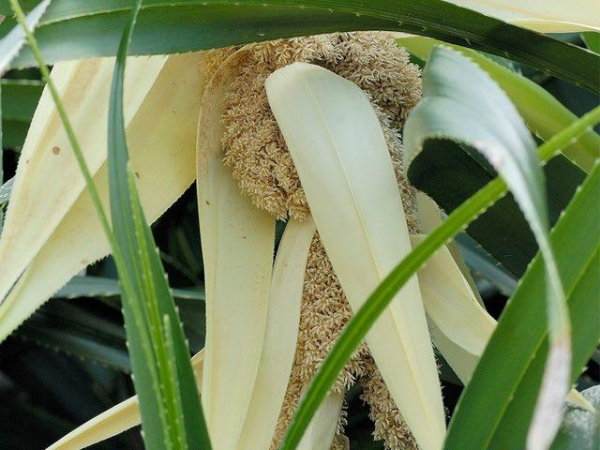
- Flowers (Inflorescence): Kewda is dioecious, with male and female flowers on separate plants. Male flowers: Grow in elongated cylindrical spikes, enclosed in fragrant creamy bracts. Female flowers: Appear as solitary terminal heads, which later develop into fruits. Both are highly aromatic, making them valuable for perfumery and traditional uses.
- Fruit: The fruit is a large, drooping cluster composed of multiple drupes. Each drupe is globose to ellipsoid, turning bright orange or red-orange when mature. Drupe segments may detach as the fruit ripens.
- Adaptations: Kewda has prop roots for support, leathery spiny leaves for protection, and aromatic flowers for pollination, which allow it to thrive in coastal, marshy, and sandy habitats with high humidity and warm temperatures.
Classical Categorisation Of Kewda (Pandanus Odoratissimus)
- Bhavaprakasha: Pushpavarga
- Raja Nighantu: Karaveeradi Varga
Ancient Verses For Kewda (Pandanus Odoratissimus)
Verse No. 1
केतकः सूचिकापुष्पो जम्बुकः क्रकचच्छदः । सुवर्णकेतकी त्वन्या लघुपुष्पा सुगन्धिनी ॥
केतकः कटुकः स्वादुर्लघुस्तिक्तः कफापहः । उष्णा तिक्तरसा ज्ञेया चक्षुष्या हेमकेतकी ॥ Bhavprakash Nighantu Pushpa Varga Verse No. 42-43
This verse tells us what the Ketaki plant (Screw Pine) looks like and its varieties
- The common Ketaka: It is known for having flowers that look like needles (Suchikapushpa) and leaves with edges like a saw (Krakacacchada).
- The Golden Ketaka: There is a second type called Suvarna-ketaki. Its flowers are smaller, but they have a very strong and pleasant fragrance.
Benefits and Nature
- Ketaka (General): It has a mix of pungent, sweet, and bitter tastes. It is light on the stomach and helps in eliminating excessive Kapha.
- Golden Ketaka: This specific variety is “warm” in nature. Most importantly, it is described as being very good for the eyes.
Verse No. 2
केतकी तीक्ष्णपुष्पा च विफला धूलिपुष्पिका । मेध्या कण्टदला चैव शिवद्विष्टा नृपप्रिया ॥
क्रकचा दीर्घपत्रा च स्थिरगन्धा तु पांशुला । गन्धपुष्पेन्दुकलिका दलपुष्पा त्रिपञ्चधा ॥ Raj Nighantu Karveeradi varga Verse No. 67-68
- Physical Traits: This plant has sharp wers (Tikshnapushpa), long leaves (Dirghapatra), and thorny edges like a saw (Kantdala, Karkacha).
- Fragrance: It is known for its long-lasting scent (Sthirgandha) and for being full of pollen or “dusty” (Dhulipushpika).
- Usage: It is liked by kings (Nrippriya) but is specifically not used in the worship of Lord Shiva (Shiva Dvishta).
Ayurvedic Properties Of Kewda (Pandanus Odoratissimus)
- Rasa (Taste): Bitter (Tikta), Sweet (Madhura), Pungent (Katu)
- Guna (Properties): Light (Laghu – easy to digest), Slimy (Snigdha)
- Vipaka (Post-digestive effect): Pungent (Katu – develops pungency after digestion)
- Veerya (Potency): Hot (Ushna)
Action On Tridosha Of Kewda (Pandanus Odoratissimus)
Balances and reduces the aggravated Kapha and Pitta doshas (Kaphapitta shamaka).
Therapeutic Indications Of Kewda (Pandanus Odoratissimus)
- Joint pain
- Headache
- Convulsions (epilepsy)
- Alopecia (hair loss)
- Earache
- Fever
- Measles
- Threatened abortion
- Weak uterine muscles
- Low sexual vigor / physical weakness
- Improve complexion
- Blackheads
- Indigestion
- Diabetes
Systemic Actions Of Kewda (Pandanus Odoratissimus)
Digestive System
- Stimulates digestion (Agni)
- Reduces indigestion and acidity
- Supports metabolism
Nervous System
- Calms Vata
- Acts as a mild sedative
- Useful in headache, convulsions, and stress
Musculoskeletal System
- Reduces joint pain
- Relieves muscle stiffness
- Supports mobility and flexibility
Reproductive System
- Strengthens uterine muscles
- Enhances sexual vitality and reproductive health
- Helps in threatened abortion prevention
Respiratory System
- Clears nasal congestion
- Useful in cough, asthma, and bronchitis
- Balances Kapha
Integumentary System (Skin & Hair)
- Improves complexion
- Reduces blackheads and skin blemishes
- Promotes hair health and prevents alopecia
Urinary System
- Acts as a mild diuretic
- Helps in burning micturition and urinary disorders
- Immune / General Health
Reduces fever
- Acts as a general tonic and Rasayana
- Detoxifies Ama (metabolic toxins)
Chemical Composition Of Kewda (Pandanus Odoratissimus)
Flowers (Kewda oil / attar)
- 2-Phenyl ethyl alcohol (aromatic, nervine, calming)
- Linalool (sedative, anti-inflammatory)
- α-Terpineol (antimicrobial, antioxidant)
- Terpinen-4-ol (anti-inflammatory, analgesic)
- Geraniol (antioxidant, antimicrobial)
Roots
- Alkaloids (analgesic, nervine action)
- Saponins (anti-inflammatory, tonic)
- Steroids (anti-inflammatory, hormonal support)
- Triterpenoids (antioxidant, anti-arthritic)
- Glycosides (cardiotonic, systemic support)
Leaves
- Flavonoids (antioxidant, anti-inflammatory)
- Phenolic compounds (antimicrobial, anti-oxidative)
- Tannins (astringent, wound healing)
Fruits (less used medicinally, but active principles present)
- Vitamin C (antioxidant, immunity support)
- Phenolic compounds (antioxidant activity)
Practical Uses / Health Benefits Of Kewda (Pandanus Odoratissimus)
- Calms the nervous system and helps reduce stress, anxiety, and headache due to its soothing aroma.
- Relieves joint pain, muscle ache, and inflammation when used externally in medicated oil.
- Improves digestion and appetite, helping in indigestion and bloating.
- Helps in reducing fever because of its cooling nature.
- Useful in earache, as warmed Kewda oil provides local relief.
- Promotes hair growth and reduces hair fall by strengthening hair roots.
- Improves skin complexion and helps reduce blackheads and blemishes.
- Supports the respiratory system, helping in cough and congestion.
- Enhances reproductive strength and vitality in traditional use.
- Acts as a mild diuretic, supporting urinary health.
- Strengthens immunity and supports overall wellbeing.
Part(S) Used Of Kewda (Pandanus Odoratissimus)
- Root
- Flower
Dosage Of Kewda (Pandanus Odoratissimus)
- Cold infusion: Take 40–50 ml
- Distillate: Take 30–40 ml
- Powder: Take 3–5 grams
Home Remedies Of Kewda (Pandanus Odoratissimus)
- For Headache: Apply a few drops of Kewda oil gently on the temples to relieve stress and headache.
- For Stress and Anxiety: Add a few drops of Kewda attar in warm water or diffuser and inhale the aroma for a calming effect.
- For Joint Pain: Mix Kewda oil with sesame oil and massage on painful joints to reduce pain and stiffness.
- For Indigestion: Take a small pinch of Kewda root powder with warm water after meals to improve digestion.
- For Fever and Body Heat: Drink diluted Kewda water (Kewda distillate mixed with water) to cool the body.
- For Earache: Put 1–2 drops of lukewarm Kewda oil in the ear for relief from ear pain.
- For Hair Fall: Massage the scalp with Kewda oil mixed with coconut oil to strengthen hair roots.
- For Skin Care: Apply a paste made from Kewda root powder and rose water on the face to improve complexion and reduce blemishes.
- For Cough and Congestion: Inhale steam with a few drops of Kewda oil added to hot water.
Scientific Research On Kewda (Pandanus Odoratissimus)
1. Anti-inflammatory Effect
Researchers investigated the anti-inflammatory activity of methanolic extract of Pandanus odoratissimus using experimental rat models. Inflammation was induced by carrageenan for acute response and by formalin for chronic response. The extract was administered in three doses (25, 50, and 100 mg/kg). The highest dose (100 mg/kg) produced the strongest effect, showing 68% inhibition in acute inflammation and 64.2% inhibition in chronic inflammation after 3 hours. Diclofenac sodium was used as the standard reference drug. The findings confirmed that the plant possesses strong anti-inflammatory potential.
2. Neuropharmacological (CNS Depressant) Activity
The effects of methanolic leaf extract were studied in albino mice using different behavioral models. The extract was given in doses of 50, 100, and 200 mg/kg. It significantly reduced movement and motor coordination and also increased the sleeping time caused by pentobarbital. Chemical analysis of the extract confirmed the presence of biologically active compounds such as flavonoids, tannins, glycosides, saponins, terpenoids, steroids, and phenolic compounds. These results indicate that the leaves contain compounds capable of producing central nervous system depressant activity.
3. Anticancer Potential
An in-vitro study evaluated the anticancer properties of methanolic and aqueous extracts prepared from the roots and leaves of Pandanus odoratissimus. The extracts were tested using brine shrimp lethality assay and onion root tip method. The aqueous extract showed particularly strong cytotoxic activity, achieving complete lethality at 80 µg/ml and showing an LC₅₀ value of 33.33 µg/ml. These findings suggest that the plant contains compounds with promising anticancer potential and support its traditional medicinal use.
4. Hepatoprotective (Liver Protective) Activity
The liver-protective effects of methanolic extracts from different floral parts (peduncle, flower, and spathe) were studied in guinea pigs with drug-induced liver damage. The peduncle extract showed the strongest protective action by improving liver tissue structure and significantly reducing liver enzyme levels (AST, ALT, ALP), comparable to the standard drug silymarin. The flower extract showed moderate protective activity. Overall, the study confirmed that certain parts of the plant possess strong hepatoprotective properties.
Classical Products With Kewda (Pandanus Odoratissimus)
- Nirgundyadi taila
- Triphaladi taila
- Maharajaprasarini taila
- Akik Pishti
Planet Ayurveda’s Products With Kewda (Pandanus Odoratissimus)
Conclusion
Kewda (Pandanus odoratissimus) is a valuable aromatic plant with wide medicinal and cultural significance in Ayurveda. Classical texts describe its properties and therapeutic uses, while modern scientific studies support its anti-inflammatory, neuroprotective, antioxidant, anticancer, and hepatoprotective potential. Its flowers and roots are mainly used for managing headache, joint pain, digestive disorders, stress, and skin problems. The presence of bioactive compounds such as flavonoids, essential oils, and phenolics enhances its therapeutic value. In addition to its medicinal benefits, Kewda is widely used in perfumery and rituals. Overall, it remains an important herb linking traditional wisdom with modern research.