


Khubbaji / Mallow Leaves (Malva sylvestris L.) – Properties, Varieties, Composition & Dosages
Abstract
Malva sylvestris L. (Family: Malvaceae), commonly known as Gulkhair, Vilayti Kangani, or common mallow, is an erect, branched biennial to perennial herb that grows up to 120 cm in height. The plant is native to Europe, particularly Italy, and is widely distributed across Western Asia, North America, Siberia, Australia, China, and the temperate regions of the Western Himalayas from Kashmir to Kumaon at altitudes of 700–2700 meters, as well as parts of southern India. All parts of the plant are rich in mucilage, contributing to its demulcent and soothing properties. Traditionally, it is known as Khubbazi. The leaves and flowers possess a mild husk-like odour and flavour, and become mucilaginous when chewed. For centuries, the plant has been valued in traditional medicine systems for managing respiratory and digestive ailments, including cough, cold, diarrhoea, and constipation, owing to its soothing and protective effects on mucous membranes.
Scientific Classification of Malva sylvestris Linn./ Mallow Leaves/ Malvae Folia/ Khubbaji
- Kingdom: Plantae
- Phylum: Tracheophyta
- Class: Magnoliopsida
- Order: Malvales
- Family: Malvaceae
- Genus: Malva
- Species: Malva sylvestris L.
Synonym of Malva sylvestris Linn./ Mallow Leaves/ Malvae Folia/ Khubbaji
- Khubbaji
Vernacular Names of Malva sylvestris Linn./ Mallow Leaves/ Malvae Folia/ Khubbaji
- Afghani: Gulikhadmī
- Arabic: Khubāzī, Bazrul Khubbāzī
- Bengali: Khubāsi
- Bombay (Regional): Khubāsi
- English: Common Mallow, High Mallow, Blue Mallow, Marsh Mallow, Cheese Cake, Leaves of Bread, Dock
- Greek: Afīyurasfiyaghan
- Hindi: Kunzī, Vilāyatī Kangal, Chagīz
- Kannada: Saunabindigegida
- Persian: Nān-i-Kalāgh, Khubāzī, Khatmī Kochak, Tukhm-i-Khubāzī, Qūla, Panīrak, Khūbar
- Sanskrit: Suvarchalā
- Tamil: Tarikalamala
- Urdu: Khubbāzī
Habitat of Malva sylvestris Linn./ Mallow Leaves/ Malvae Folia/ Khubbaji
Malva sylvestris (common mallow) is a hardy biennial to perennial herb native to Europe, North Africa, and parts of Asia, where it thrives in temperate to subtropical climates. The plant commonly grows in sunny to partially shaded environments and prefers moist, well-drained, nutrient-rich soils. It is frequently found in disturbed habitats such as hedgerows, roadsides, riverbanks, fallow lands, cultivated fields, pastures, waste areas, and coastal regions. Although naturally distributed across Europe, Asia, and North Africa, it has been widely introduced and naturalised in regions including North America, Australia, and Mexico. The species is adaptable to various soil types but grows best in fertile loamy or sandy soils and can also occur at higher elevations under suitable environmental conditions.
Morphology of Malva sylvestris Linn./ Mallow Leaves/ Malvae Folia/ Khubbaji
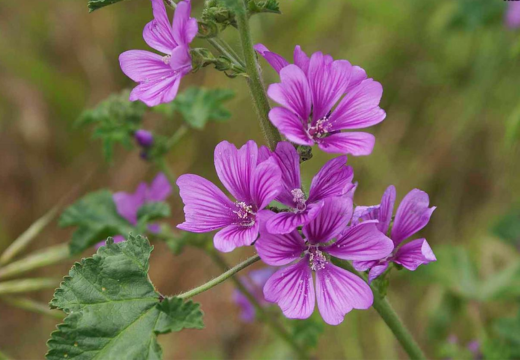
Malva sylvestris (common mallow), also known as Khubbazi, is an erect or occasionally procumbent biennial to perennial herb attaining about 0.5–2 meters in height. The plant has branched, mucilaginous stems covered with simple and stellate hairs that gradually become smoother as they mature. Leaves are alternate, round to kidney-shaped, palmately 3–7 lobed with crenate or serrated margins and supported by long petioles. They possess a slightly rough surface, more prominent on the underside, and are smaller than those of Khatmi. Fresh plant parts exude mucilage when crushed, although this property reduces after drying. The flowers are attractive, mauve to purple with darker veins, about 3–5 cm across, and arise in axillary clusters. Each flower consists of five notched petals with an epicalyx of oblong-lanceolate bracts, along with a prominent staminal tube and projecting style. The fruit is a distinctive wheel-shaped schizocarp composed of 9–11 kidney-shaped mericarps. The plant commonly grows in moist soils during the Kharif season and continues through spring into early summer, often propagating naturally by self-seeding. A related species, Malva rotundifolia, differs by having smaller leaves and flowers with a low-growing, spreading habit.
Varieties of Malva sylvestris Linn./ Mallow Leaves/ Malvae Folia/ Khubbaji
There is another variety named Malva rotundifolia Linn., which is also known as Khubbaji.
Ayurvedic properties of Malva sylvestris Linn./ Mallow Leaves/ Malvae Folia/ Khubbaji
- Potency (Veerya )– Cold Potency (Sheet)
Therapeutic Indications of Malva sylvestris Linn./ Mallow Leaves/ Malvae Folia/ Khubbaji
- Respiratory System: Helpful in cough, cold, bronchial congestion, and sore throat; acts as an expectorant and antitussive.
- Gastrointestinal Tract: Supports relief in constipation, diarrhoea, and digestive disturbances; shows anti-ulcer properties.
- Dermatological Use: Promotes wound healing, reduces inflammation (eczema), helps in acne, and soothes skin irritation as an emollient.
- Urological & Systemic Uses: Acts as a diuretic, useful in urinary disorders and menstrual pain.
- Other Uses: Exhibits hepatoprotective, antimicrobial, and potential anti-cancer activities.
Systemic actions of Malva sylvestris Linn./ Mallow Leaves/ Malvae Folia/ Khubbaji
External Uses
It is beneficial in the management of acne and pimples when applied externally.
Internal Uses
Respiratory System
It is effective in the management of cough and other respiratory problems.
Excretory System
It is used to manage the burning sensation in the urinary bladder.
Chemical composition of Malva sylvestris Linn./ Mallow Leaves/ Malvae Folia/ Khubbaji
- Mucilage & Polysaccharides: Acidic polysaccharides composed of glucose, galactose, arabinose, and rhamnose.
- Flavonoids: Quercetin, kaempferol, rutin, myricetin, apigenin, genistein, gossypetin, and hypolaetin derivatives.
- Anthocyanins: Malvidin, malvidin-3,5-diglucoside (malvin), malvidin-3-O-glucoside, and delphinidin derivatives.
- Phenolic Compounds & Acids: Chlorogenic acid, caffeic acid, ferulic acid, salicylic acid, hydroxybenzoic acid derivatives, and polyphenols.
- Coumarins: Scopoletin and related methoxycoumarins.
- Terpenoids: Mono-, sesqui-, and diterpenes.
- Fatty Acids: Linoleic acid, oleic acid, and palmitic acid.
- Organic Acids: Citric, malic, fumaric, and oxalic acids.
- Vitamins: Vitamins A, C, and E (tocopherols), along with niacin and folic acid.
- Other Compounds: Tannins, sterols, saponins, alkaloids, malvone A, and malvaline.
Actions and Properties of Various Chemical Constituents of Malva sylvestris Linn./ Mallow Leaves/ Malvae Folia/ Khubbaji
For Respiratory system
The effectiveness of Malva sylvestris (common mallow) in managing cough and respiratory disorders is mainly due to its rich mucilage content present in the flowers and leaves. These mucilage polysaccharides, composed of sugars such as galacturonic acid, rhamnose, galactose, glucose, and arabinose, form a protective demulcent layer over irritated throat and bronchial mucosa, thereby soothing dryness and reducing cough reflex. Flavonoids like gossypin and malvin, along with anthocyanins such as malvidin and delphinidin, exert anti-inflammatory and antioxidant actions that help decrease airway inflammation. Phenolic acids, including ferulic and caffeic acid, further support respiratory healing by reducing oxidative stress. Additionally, tannins provide mild astringent effects that relieve irritation of the throat and oral mucosa. Through these combined actions, the plant calms inflamed tissues, eases breathing, and promotes recovery in respiratory conditions.
Anticancer Activity
The anticancer and antineoplastic activity of Malva sylvestris (common mallow) is attributed to its rich content of polyphenols, flavonoids, anthocyanins, and plant-derived microRNAs present in the flowers and leaves. A notable component, miR160b-5p, acts through a cross-kingdom regulatory mechanism by reducing the expression of the human CDK2 gene, thereby inhibiting uncontrolled cancer cell proliferation. Flavonoids such as gossypin and hypolaetin, along with anthocyanins like malvidin derivatives, help regulate oxidative balance and induce cell cycle arrest and cellular senescence in tumour cells. Malvone A, a phytoalexin compound, contributes cytotoxic and antimetastatic effects, limiting cancer cell spread. Coumarins such as scopoletin further enhance anticancer activity through antioxidant and signalling modulation actions. Collectively, these constituents suppress tumour growth, reduce cell invasiveness, and interfere with cancer-promoting pathways while showing relatively low toxicity toward normal cells.
Practical Uses / Health Benefits of Malva sylvestris Linn./ Mallow Leaves/ Malvae Folia/ Khubbaji
- Tea: Boil 2–4 teaspoons of dried leaves or flowers in about 150 ml of water for 10–15 minutes and consume up to three times daily to relieve cough and digestive discomfort.
- Cold Infusion (For Skin Care): Soak 6 teaspoons of dried herb in 1 quart of cold water overnight to extract maximum mucilage, then use for soothing skin irritation.
- Poultice: Apply crushed fresh leaves or soaked dried leaves directly over insect bites, swellings, or boils to reduce inflammation.
- Culinary Use: Tender leaves and young shoots may be eaten fresh in salads or cooked as vegetables, offering nutritional benefits.
Parts Used of Malva sylvestris Linn./ Mallow Leaves/ Malvae Folia/ Khubbaji
- Leaves
- Flowers
Conclusion
Malva sylvestris (Common mallow or Khubbāzī) is a valuable medicinal herb widely recognised in traditional systems of medicine for its soothing, anti-inflammatory, and healing properties. It is rich in mucilage, flavonoids, phenolic compounds, and vitamins. The plant demonstrates significant therapeutic potential in managing respiratory, gastrointestinal, dermatological, and urinary disorders. Its demulcent action helps protect irritated tissues, while antioxidant and antimicrobial constituents support overall health and recovery. Due to its safety, nutritional value, and broad spectrum of medicinal applications, Malva sylvestris continues to serve as an important natural remedy.