


Mahanimba / Bead Tree / Persian Lilac – Properties, Varieties, Composition & Dosages
Abstract
Melia azedarach, commonly known as Chinaberry or Persian lilac, is a deciduous tree valued in traditional medicine for its wide range of therapeutic applications. It belongs to the Meliaceae family and is native to tropical and subtropical regions of Asia and Australia. Various parts of the tree, particularly the leaves, bark, and fruits, are used in Ayurvedic formulations for their antimicrobial, anti-inflammatory, and anthelmintic properties. The tree also has historical significance in local cultures due to its utility in natural healing. Its strong, bitter taste and potent medicinal compounds make it effective in treating skin, digestive, and parasitic conditions. Modern studies support many traditional uses, emphasising its pharmacological importance.
Introduction
Melia azedarach has been traditionally employed in folk and Ayurvedic medicine for centuries, especially for treating infections, intestinal worms, and skin disorders. It is known for its intense bitterness. The plant possesses several bioactive compounds with therapeutic value. It is often confused with Azadirachta indica (Neem), though they differ in botanical features and potency. The entire plant, including its leaves, stem, and roots, possesses medicinal properties and has been traditionally used for generations by indigenous and tribal communities in India. The tree is well adapted to a range of climates and soils, making it a widespread species in India and other Asian countries. Its seeds and bark are particularly known for their strong purgative and anti-parasitic actions. Scientific interest in this plant has grown due to its potential in herbal drug development.
Scientific Classification
- Kingdom: Plantae
- Phylum: Tracheophyta
- Class: Magnoliopsida
- Order: Sapindales
- Family: Meliaceae
- Genus: Melia
- Species: Melia azedarach Linn.
Synonym
- Mahodreka
- Karmuka
- Keshamushtika
- Kakanta
- Ramyaka
- Aksahira
- Mahatikta
- Himadruma
- Jiva
- Vishamushtika – It is useful in rat poisoning
Vernacular Names
- Annam: Cay sau dau, Cay xaon, Cay xaondau, Chao maulein, Sandan, Xun lien, Yu mou
- Arabic: Habulban, Ban
- Assamese: Thamaga
- Baluchi: Bakain, Bakaur
- Bengali: Ghoranim, Mahanim
- Bombayese: Bakayan, Drek, Mahalimbo, Nimb, Vilayatinim
- Burmese: Kamaka, Tamaka
- Canarese (Kannada): Arebevu, Bevu, Garudabevu, Huchubevu, Sikkabevu, Vishabevu
- Chinese: Lien, Lien Chou
- Deccan: Giuliani, Gourami
- Dutch: Onevaderboom, Paternoster boom
- English: Barbados lilac, Bead tree, Indian lilac, Persian lilac, Pride of China, Pride of India
- French: Agemlilasazedarach, Bipinneazedarachcommun, Arbeachapelete, Jasmine de parse, Laurier grec, Lilas de Chine, Lilas des Indes
- Garhwali: Denkana
- German: Peternosterbaum, Zedrach
- Gujarati: Bakanlim, Bodo
- Hindi: Bakain, Balkarja, Bakayan, Betain, Deikna, Drek, Mahanimb
- Japanese: Senndan, Senyoosi, Shen lien
- Konkani: Vilayatinimb
- Kumaoni: Dain kan
- Malayalam: Malaveppu
- Marathi: Bakananimb, Limbara, Vilayatinimb
- Mexican: Arbol paraiso, Lila paraiso, Morado
- Nepalese: Bakain, Bakaina, Bakainu
- Persian: Bakaen
- Philippines: Paraiso
- Portuguese: Bomboloni n puto
- Punjabi: Bakain, Chein, Dhek, Drake Kitchen
- Pushtu: Bakayana
- Sanskrit: Akshadaru, Brihannimba, Dreka, Gairika, Mahanimba, Mahatikta, Nimbaka
- Sindhi: Bakayun, Drek
- Sinhalese: Lunumidella, Mahanimba
- Spanish: Acedaraque, Cinamomo
- Tahiti: Tira
- Tamil: Malaivembu, Malaveppu, Pisidam, Sigarinimbam
- Telugu: Turakavepa, Vettiveppa
- Urdu: Bakayan
- Venezuelan: Alcli
Habitat
Melia azedarach is native to tropical regions of Asia and is commonly found across Pakistan, India, Indonesia, Southeast Asia, and Australia. It has also become naturalised in several other parts of the world, including the Philippines, the United States, Brazil, Argentina, and various countries in Africa and the Arab region.
Morphology
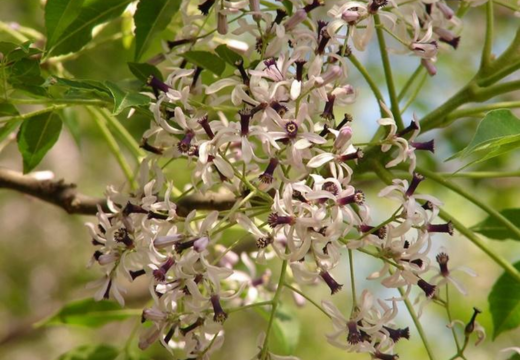
Melia azedarach L. is a deciduous tree that can grow up to 45 meters in height. The trunk is fluted at the base in older trees, with a diameter ranging from 30 to 60 cm, and occasionally reaching up to 120 cm. It has a spreading crown with sparsely branched limbs. The bark is smooth and greenish-brown in young trees, gradually turning grey and fissured with age. The leaves are quite variable—they may be alternate or opposite, and range from pinnate, unifoliolate, ternate, bifoliolate, bipinnate compound, to simple forms, typically measuring 12–24 mm in length. The flowers range from minute to moderately large and may be white, greenish-white, or purple. They are calyptrate, regular, cyclic to polycyclic in arrangement, and measure about 0.25–0.3 mm in length. The flowers are fragrant and borne in long-peduncled axillary panicles measuring 3–9 mm. The lilac-colored petals surround a prominent purple stamina tube, 0.2–0.3 mm long, which is slightly ribbed on the outside. The fruits are typically fleshy or non-fleshy, five-seeded capsules or berries that lack a fleshy outer layer. The capsules may dehisce either septicidally or loculicidally. The mature fruits are ellipsoid to globose, yellow, and measure 0.5–0.6 mm in length. They usually contain four seeds, have 3–6 cells, and remain on the tree long after ripening, eventually becoming wrinkled.
Varieties
Here are some of the varieties of Neem:
- Nimba – Azadirachta indica
- Mahanimba – Melia azedarach
- Parvata Nimba – Ailanthus excelsa
- Akasha Nimba – Millingtonia hortensis
Classical Categorisation
-
According to Sushruta Samhita-
- Adhobhagahara
- Pippalyadi Varga
- According to Bhavprakash Nighantu- Guduchyadi Varga
Ancient Verses
महानिम्बो हिमो रूक्षस्तिक्तो ग्राही कषायकः ॥
कफपित्तभ्रमच्छर्दिकुष्ठहल्लासरक्तजित् ।
प्रमेहश्वासगुल्मार्गोमूषिकाविषनाशनः॥(Bhavprakash Nighantu Guduchyadi varga 98-99)
According to the above shloka, Mahanimba has cold potency, dry nature, bitter and astringent taste and absorbent properties. It is effective in the management of Kapha, Pitta, delusion/ vertigo, vomiting, leprosy, bleeding disorders, diabetes, respiratory diseases, abdominal lump, piles and poisoning due to rat bite.
Ayurvedic Properties
- Taste (Rasa)- Bitter (Tikta), Astringent (Kashaya)
- Physical property (Guna)- Dry (Ruksha)
- Potency (Veerya)- Cold Potency (Sheet)
- Post-digestion effect (Vipaka)- Katu (Pungent)
- Effect on tridosha- Balance Pitta and Kapha dosha
Therapeutic Properties
- Relieves burning sensation
- Relieves fatigue
- Diuretic
- Increases body strength
Systemic actions
External uses – It is effective in the management of headaches when applied externally as a paste. Its paste is also used for the management of skin problems, acarid, and pimples.
Internal Uses
- Digestive system- It is effective in cases of piles and worm infestation. For piles management, its seed is used, and in case of worm infestation, its bark is used.
- Nervous system- It is useful in the management of sciatica.
- Respiratory System- It is very effective in the management of various bleeding disorders.
- Reproductive System- It is also used in cases of painful menstruation.
- Urinary System- Its use in the management of diabetes is very effective.
- Skin- It is widely used in the management of skin disorders, especially leprosy.
Chemical Composition
Roots
- Terpenoids & Limonoids:
- 6-Acetoxy-7α-hydroxy-3-oxo-14β,15β-epoxymeliac-1,5-diene
- 6-Acetoxy-3β-hydroxy-7-oxo-14β,15β-epoxymeliac-1,5-diene-3-O-β-D-glucopyranoside
- Azecin-1, Azecin-2, Azecin-3, Azecin-4
- Flavonoids:
- Apigenin-5-O-β-D-galactopyranoside
- Steroids:
- 24-Methylenecycloartanol, 24-Methylenecycloartanone
- 4-Stigmastanen-3-one, 4-Campestene-3-one
- β-Sitosterol, β-Sitosterol-β-D-glucoside
- Acids:
- Trans-cinnamic acid
- Vanillic acid (4-Hydroxy-3-methoxy benzoic acid)
Root Bark
- Terpenoids & Limonoids:
- 12-O-Acetyl azadirachtin-A, 12-O-Acetyl azedarachin-B
- 1-Acetyl-3-tigloyl-11-methoxymeliacarpinin
- 12-O-Acetyl trichilin-B, 2α-Acetyl-29-deacetyl-29-isobutyrylsendanin
- Azedarachin-A, Azedarachin-C, Trichilin-B, Trichilin-D, Trichilin-H
- 1-Cinnamoyl derivatives of meliacarpinin
- Nimbolidin-B, Meliacarpinin E, Salannin
- Multiple acetylated and tigloylated meliacarpinins
- Steroids:
- 6β-Hydroxy-4-campesten-3-one
- 6β-Hydroxy-4-stigmasten-3-one
- Azeclarachol
Fruits
- Terpenoids & Limonoids:
- 6-Acetoxy-14,15-epoxy-3,11-dihydroxymeliac-1,5-diene-7-one
- Amoorastatin, Amorastatone
- Azadirachtin-A, Melianol, Melianone, Meliantriol
- Meliatoxins (A1, A2, B1, B2)
- Nimbolidin-A, Nimbolinin-A, Nimbolinin-B
- Ohchinal, Ohchinin, Ohchinolide-A, B
- Sendanin, Sendanal, Sendandal
- Vilasinin, Gedunin, Meliandiol
- 3-O-Tigloylohchinin, 21-β-Acetoxymelianone
- Acids:
- Stearic acid (octadecanoic acid), Trans-cinnamic acid
- Others:
- Methylkulonate, 3-α-Tigloylmelianol
Leaves
- Terpenoids & Limonoids:
- Deacetylsalannin
- 1,3-Dicinnamoyl-11-hydroxy-meliacarpin
- α-Pinene, β-Pinene, α-Terpinene, α-Terpineol
- Flavonoids:
- Kaempferol-3-O-β-rutinoside
- Kaempferol-3-L-rhamno-D-glucoside
- Rutin
- Acids:
- Palmitic acid (Hexadecanoic acid)
Stem Bark
- Terpenoids & Limonoids:
- 7α-Acetoxy-14β,15β-epoxygedunanl-ene-3-O-β-D-glucopyranoside
- 12-Acetoxyamoorastatin, Fraxinellone
- 12-Hydroxyamoorastatone
- 3-Hydroxy eupha-7,24-diene-21,16-olide
- Kulatone, Kulinone, Kulolactone
- Methylmalonate
- α-Pinene, β-Pinene, α-Terpinene, α-Terpineol
- Flavonoids:
- 4′,5-Dihydroxyflavone-7-O-α-L-rhamnopyranosyl-(1→4)-β-D-glucopyranoside
- Anthraquinones:
- 1,3,5,8-Tetrahydroxy-2-methyl anthraquinone
- 1,5-Dihydroxy-8-methoxy-2-methyl anthraquinone
- 3-O-α-L-rhamnopyranoside derivatives
- Galactopyranosidase derivatives
Stem Wood
- Terpenoids & Limonoids:
- Melianin-A
- Melianin-B
Modern overview
Antiviral action
Meliacarpin, a triterpenoid compound isolated from the purified extract of Melia azedarach leaves, has demonstrated potent antiviral activity in in vitro studies. It specifically inhibits the replication of Vesicular Stomatitis Virus (VSV) and Herpes Simplex Virus (HSV) when administered after viral infection, indicating a post-entry mechanism of action. Research suggests that Meliacarpin may interfere with viral RNA synthesis or protein translation, thereby halting the production of viral components necessary for replication. Importantly, these effects occur without cytotoxicity, meaning it does not harm normal host cells. This makes it a promising lead compound for the development of plant-based antiviral therapies. Further studies are needed to clarify its exact molecular targets and pathways involved in viral suppression.
Antidiabetic action
Melia azedarach (Chinaberry) exhibits significant antidiabetic potential due to the presence of bioactive compounds such as flavonoids, alkaloids, terpenoids, saponins, meliatoxins, and glycosides. Studies have shown that methanol extracts of its leaves and fruits can inhibit protein tyrosine phosphatase-1B (PTP-1B), an enzyme that negatively regulates insulin signalling. By inhibiting PTP-1B, the extract helps enhance insulin sensitivity and promotes better glucose utilisation. Additionally, these extracts stimulate glucose uptake in peripheral tissues, supporting improved glycemic control. The combined effects of these phytochemicals contribute to reducing blood sugar levels, making Melia azedarach a promising natural agent in diabetes management. Further research is needed to isolate and evaluate individual components for therapeutic use.
For abdominal lumps
Melia azedarach may help in managing abdominal lumps due to its combination of anti-inflammatory, anti-tumoral, skin-healing, and blood-purifying properties. The presence of limonoids and other active phytochemicals helps reduce inflammation and abnormal tissue growth, which are common causes of such lumps. If the lump is due to a benign tumour or inflammatory swelling, these compounds may help reduce its size and discomfort. Its blood-purifying and anti-allergic actions may support the elimination of toxins and reduce immune-related swelling. Together, these actions suggest a holistic effect on abdominal lumps, especially when they stem from inflammatory, infectious, or immune-mediated causes.
Practical uses
- Leaf Juice or Decoction: Used as an anthelmintic, astringent, and stomachic.
- For Dysmenorrhoea: Leaf paste mixed with water is administered to provide immediate relief from pain and discomfort.
- As an Emmenagogue: Leaf paste promotes menstrual flow.
- For Skin Eruptions: Flower paste is applied externally.
- For Spleen Enlargement: Gum paste is used therapeutically.
- For Leprosy and Worm Infestation: Fruits are used in the management of leprosy, while the bark acts as an anthelmintic.
- For Asthma and Chest Disorders: Stem bark is beneficial in treating asthma and chest-related ailments.
- For Malaria Fever: A decoction of leaves and flowers is administered.
- For Low-grade Fever: Bark decoction mixed with honey is given.
- For Bronchitis in Infants: Steamed leaves are tied over the abdomen and chest to provide relief.
- For Severe Cough Associated with Tuberculosis: Leaf juice taken on an empty stomach in the morning is considered beneficial.
- Veterinary Use: A mixture prepared from 1 kg of fruit and 1 kg of barley fermented in curd for one week is filtered, and 200 ml of the filtrate is administered once daily to cattle suffering from weakness, reduced milk secretion, and loss of appetite.
Parts Used
- Root
- Bark
- Fruit
- Seed
Dosage
- Decoction – 50–100 ml
- Bark – 3–6 g
- Fruit pulp – 250–1000 mg
Conclusion
Melia azedarach, commonly known as Chinaberry or Persian Lilac, is a versatile medicinal tree valued in traditional systems of medicine for its wide range of therapeutic benefits. It is rich in bioactive compounds such as triterpenoids, flavonoids, and limonoids. This plant exhibits properties like antimicrobial, anthelmintic, anti-inflammatory, insecticidal, and antidiabetic effects. Different parts of the tree, such as leaves, bark, fruit, and seeds, are utilised for treating ailments like skin diseases, intestinal worms, respiratory issues, and inflammatory conditions. Overall, Melia azedarach holds significant promise as a medicinal resource, meriting further scientific exploration and careful therapeutic application.