


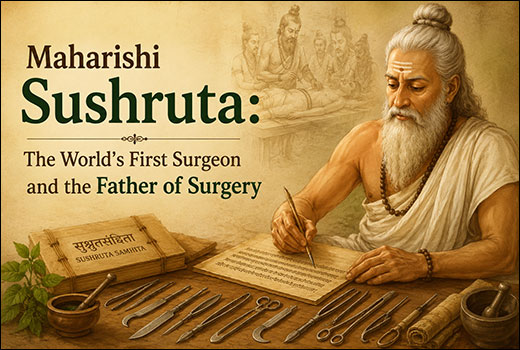
Maharishi Sushruta: The World’s First Surgeon and the Father of Surgery
Abstract
Maharishi Sushruta is revered as one of the greatest physicians and surgeons in the history of medicine. Honored as the Father of Surgery and the Father of Plastic Surgery, He revolutionized surgical practice over 2,500 years ago through His systematic approach to anatomy, operative techniques, surgical education, and patient care. His seminal work, the Sushruta Samhita, is one of the oldest and most comprehensive surgical texts, describing hundreds of surgical procedures, specialized instruments, disease classifications, and ethical principles of medical practice. Maharishi Sushruta’s pioneering contributions laid the foundation for several surgical specialties, including reconstructive surgery, ophthalmology, orthopedics, and traumatology. His emphasis on practical training and scientific observation continues to influence modern medicine. In recognition of His extraordinary contributions, a bronze statue of Maharishi Sushruta was unveiled at the Royal College of Surgeons of Edinburgh in June 2026. This article explores the life of Maharishi Sushruta, His remarkable contributions to surgery and medical science, the significance of the Sushruta Samhita, His influence on modern medicine, and the growing international recognition of His enduring legacy.
Introduction
Maharishi Sushruta is widely regarded as one of the earliest and most influential surgeons in medical history. Believed to have lived around the 6th century BCE in Kashi (present-day Varanasi), He transformed surgery into a systematic scientific discipline through His unparalleled knowledge and innovative techniques. Under the guidance of Lord Dhanvantari, Maharishi Sushruta mastered both medicine and surgery, emphasizing observation, practical training, precision, and ethical medical practice. His greatest contribution, the Sushruta Samhita, remains one of the oldest and most authoritative surgical treatises in the world. It documents numerous surgical procedures, anatomical concepts, specialized instruments, and principles of patient care, many of which remain relevant today. Maharishi Sushruta’s pioneering work in reconstructive surgery, ophthalmology, fracture management, and surgical education earned Him the enduring titles of the Father of Surgery and the Father of Plastic Surgery. His contributions continue to inspire medical professionals worldwide and stand as a testament to the advanced scientific knowledge of ancient India.
Early Life And Historical Background
Although the exact details of Maharishi Sushruta’s life remain uncertain, scholars generally place Him in the 6th century BCE in the ancient city of Kashi, a renowned center of learning and medicine. According to Ayurvedic tradition, He was a disciple of Lord Dhanvantari, from whom He acquired extensive knowledge of medicine and surgical science. At a time when injuries, fractures, and traumatic wounds were common, Maharishi Sushruta developed systematic surgical techniques to treat a wide range of conditions. He emphasized detailed anatomical knowledge, practical training through cadaveric dissection and simulated practice, and strict ethical conduct before performing surgery on patients. His scientific approach transformed surgery into an organized medical discipline and established principles that continue to influence surgical education and practice today.
The Sushruta Samhita: The Foundation Of Surgical Science
The Sushruta Samhita is one of the oldest and most comprehensive medical treatises, authored by Maharishi Sushruta. It is regarded as the foundation of Shalya Tantra (surgery) in Ayurveda and provides a systematic account of surgical principles, anatomy, diagnosis, treatment, and medical ethics. The text describes over 300 surgical procedures, 120 surgical instruments, approximately 700 medicinal plants, and more than 1,100 diseases. It also covers diverse branches of medicine, including ophthalmology, orthopedics, obstetrics, toxicology, wound management, and reconstructive surgery. A distinguishing feature of the Sushruta Samhita is its emphasis on practical training. Maharishi Sushruta advocated cadaveric dissection and simulated practice on natural materials before performing surgery on patients. The treatise also highlights the importance of hygiene, preoperative preparation, postoperative care, and ethical medical practice, many of which remain relevant in modern surgery.
Classification Of Surgical Procedures
Maharishi Sushruta classified surgical procedures into eight basic operative techniques (Ashtavidha Shastra Karma):
- Chedya – Excision
- Bhedya – Incision
- Lekhya – Scraping
- Vedhya – Puncturing
- Eshya – Probing
- Aharya – Extraction
- Visravya – Drainage
- Sivya – Suturing
This systematic classification laid the foundation for organized surgical practice and reflects Maharishi Sushruta’s advanced understanding of operative principles.
Major Contributions Of Maharishi Sushruta To Surgery
Maharishi Sushruta revolutionized surgery by developing innovative operative techniques and establishing systematic surgical principles that continue to influence modern medicine. In the Sushruta Samhita, He documented more than 300 surgical procedures and described 120 specialized surgical instruments, making it one of the earliest and most comprehensive surgical treatises in the world. His landmark contributions include:
- Rhinoplasty (Nasal Reconstruction): Maharishi Sushruta pioneered reconstructive plastic surgery by describing the forehead flap rhinoplasty technique, in which skin from the forehead was used to reconstruct severed or deformed noses. This procedure is regarded as the foundation of modern plastic surgery.
- Cataract Surgery: He described one of the earliest surgical treatments for cataracts using the couching technique, in which a specialized curved instrument was used to displace the opaque lens and restore vision.
- Lithotomy (Bladder Stone Removal): Maharishi Sushruta developed surgical methods for removing urinary bladder stones while minimizing injury to surrounding tissues, demonstrating remarkable precision for His time.
- Repair of Cleft Lip: He documented reconstructive techniques for correcting cleft lips and other facial deformities, significantly improving both function and appearance.
- Abdominal and Intestinal Surgery: He described surgical management of intestinal obstruction, hernias, and other abdominal conditions, highlighting careful operative techniques and postoperative care.
- Fracture and Trauma Management: Maharishi Sushruta classified fractures and dislocations, explained methods of bone reduction, splinting, and wound management, laying the foundation for orthopedic and trauma surgery.
- Ear Reconstruction (Lobuloplasty and Otoplasty): He introduced reconstructive procedures to repair torn earlobes and damaged external ears, demonstrating His expertise in restorative surgery.
Maharishi Sushruta’s Surgical Instruments
Maharishi Sushruta classified His surgical instruments into two major categories: Yantras (blunt instruments) and Shastras (sharp instruments). He described 101 Yantras and 20 Shastras, together forming approximately 120 specialized surgical instruments, each designed for a specific surgical purpose. These instruments were primarily made of high-quality steel and reflected remarkable precision in design and function.
Yantras (Blunt Instruments)
These instruments were mainly used for grasping, probing, extracting, dilating, and supporting tissues.
- Swastika Yantra – forceps-like instruments
- Sandansha Yantra – pincers or extraction forceps
- Tala Yantra – instruments used mainly in ear and nasal procedures
- Nadi Yantra – tubular instruments or catheters
- Shalaka Yantra – probes and rods
- Upayantra – auxiliary surgical instruments
Shastras (Sharp Instruments)
These cutting instruments were used for incision, excision, puncturing, scraping, and dissection.
- Mandalagra – circular-tipped knife
- Karapatra – saw
- Vriddhipatra – scalpel
- Nakha Shastra – nail-shaped knife
- Mudrika – ring knife
- Utpalapatra – lotus leaf-shaped knife
- Ardhadhara – single-edged knife
- Suchi – surgical needle
- Kushapatra – grass leaf-shaped knife
- Atimukha – beak-shaped knife
- Trikurchaka – three-pronged instrument
- Vetasapatra – reed leaf-shaped knife
- Badisha – surgical hook
- Dantashanku – dental instrument
- Eshani – probe
- Ara – awl or perforator
- Kartari – scissors
Maharishi Sushruta emphasized that surgical instruments should be sharp, durable, well-balanced, sterile, and properly maintained to ensure precision and patient safety. His systematic classification and meticulous design of surgical instruments demonstrate His profound understanding of operative techniques and remain one of His greatest contributions to the history of surgery.
Maharishi Sushruta’s Surgical Education And Training
- Maharishi Sushruta believed that a skilled surgeon must possess both theoretical knowledge and practical experience. He advocated a structured system of surgical education in which students first mastered anatomy and disease pathology before performing operative procedures.
- To develop surgical skills, He recommended cadaveric dissection for studying human anatomy and encouraged repeated practice on fruits, vegetables, leather bags, wax models, and animal tissues to simulate surgical procedures. Only after achieving proficiency through such training were students permitted to operate on patients.
- Maharishi Sushruta also emphasized discipline, compassion, ethical conduct, and continuous learning as essential qualities of a surgeon. His emphasis on simulation-based learning and hands-on training closely resembles the principles followed in modern medical education.
Maharishi Sushruta’s Knowledge Of Human Anatomy
Maharishi Sushruta recognized that a thorough understanding of human anatomy was essential for successful surgery. Maharishi Sushruta described 360 bones, numerous joints, muscles, vessels, and vital points (Marmas), highlighting their surgical importance. He strongly advocated cadaveric dissection as the most effective method for learning anatomy. Students were instructed to carefully study the human body to understand the location and relationship of different structures before performing surgical procedures. This practical approach made Maharishi Sushruta one of the earliest physicians to promote anatomical dissection as a core component of medical education.
Maharishi Sushruta’s Contributions To Anesthesia
Although modern anesthesia had not yet been developed, Maharishi Sushruta introduced methods to minimize pain and improve patient comfort during surgical procedures. His contributions include:
- Recommended the use of wine (Madya) to induce sedation and reduce pain before surgery.
- Advised the administration of herbal preparations with sedative and analgesic properties to facilitate operative procedures.
- Recognized the importance of relieving pain and calming the patient before performing surgery.
- Emphasized adequate patient preparation to improve surgical outcomes and reduce operative distress.
- His use of sedative substances represents one of the earliest documented forms of anesthesia in the history of medicine.
Maharishi Sushruta’s Medical Ethics And Patient Care
Maharishi Sushruta believed that a physician should possess not only technical expertise but also compassion, integrity, and self-discipline. He emphasized that the welfare of the patient should always be the foremost priority. The Sushruta Samhita outlines ethical principles such as obtaining the patient’s trust, maintaining confidentiality, providing unbiased treatment, and practicing with honesty and competence. Maharishi Sushruta also stressed careful patient selection, thorough preoperative assessment, proper postoperative care, and maintaining cleanliness to reduce complications and promote recovery. These principles highlight His holistic approach to healthcare and continue to reflect the ethical values upheld in modern medical practice.
Maharishi Sushruta’s International Recognition
The global recognition of Maharishi Sushruta spans across centuries, establishing him as a foundational figure in world medicine through historical translations, global archival preservation, and modern international honors:
- Early Global Expansion via Arabic Translations: The Sushruta Samhita transitioned beyond India’s borders around the 8th century CE. It was translated into Arabic under the patronage of Caliph Mansur, becoming known in the Arab world as Kitab Shah Shun Al-Hindi or Kitab-i-Susurud.
- Western Academic Adoption: During the 19th century, the treatise gained prominence in European medical academia. It was translated into Latin by Dr. Franciscus Hessler and into German by the acclaimed scholar Max Muller.
- Inaugural English Translation: The text became accessible to the English-speaking world in 1907 through the first English translation completed by Kaviraj Kunjalal of Calcutta.
- Archival Preservation in the United States: A rare and historic palm leaf manuscript of the Sushruta Samhita is carefully preserved and curated at the Los Angeles County Museum of Arts in the USA.
- Institutional Tributes in Australia: In 2018, the Royal Australasian College of Surgeons formally recognized his monumental impact on surgical history by erecting a statue of Maharishi Sushruta on their campus.
- Acclaimed from Modern Surgery: His pioneer status is highly regarded by Western medical pioneers, as emphasized by the prominent American surgeon Dr. Allen Whipple, who famously remarked that Sushruta must be considered the greatest surgeon of the pre-medieval period.
- Bronze Statue at the Royal College of Surgeons of Edinburgh (2026): In June 2026, a bronze statue of Maharishi Sushruta was unveiled at the Royal College of Surgeons of Edinburgh, Scotland. The statue honors His pioneering contributions to surgery and symbolizes the global recognition of India’s ancient medical heritage.
Legacy Of Maharishi Sushruta
- Maharishi Sushruta’s contributions have had a profound and lasting impact on the evolution of surgery and medical science. His legacy continues to inspire healthcare professionals across the world.
- Established the scientific foundation of surgery through systematic observation, practical training, and evidence-based techniques.
- Authored the Sushruta Samhita, one of the earliest and most comprehensive surgical treatises in medical history.
- Introduced ethical principles for physicians, emphasizing compassion, discipline, patient welfare, and professional responsibility.
- Advocated hands-on surgical training using models made from fruits, vegetables, leather bags, and animal tissues before operating on patients.
- Standardized preoperative preparation, operative procedures, and postoperative care, many of which remain fundamental principles in modern surgery.
- Described numerous surgical instruments and operative techniques that influenced the development of surgical practice for centuries.
- Inspired generations of physicians and surgeons, with His teachings continuing to be studied in Ayurveda, the history of medicine, and surgical education worldwide.
- Remains an enduring symbol of India’s rich scientific and medical heritage, demonstrating the advanced state of ancient Indian healthcare.
Conclusion
Maharishi Sushruta stands as one of the greatest pioneers in the history of medicine, whose extraordinary contributions transformed surgery into a systematic scientific discipline. Through the Sushruta Samhita, He established comprehensive principles of surgical practice, anatomy, medical ethics, operative techniques, and physician training that were centuries ahead of their time. His innovations in reconstructive surgery, ophthalmology, orthopedics, trauma management, and surgical instrumentation continue to be recognized as milestones in the evolution of modern medicine. His emphasis on practical training, patient-centered care, and ethical medical practice reflects principles that remain fundamental to contemporary healthcare. More than 2,500 years after His lifetime, Maharishi Sushruta’s legacy continues to inspire surgeons, physicians, researchers, and medical historians across the world. His enduring influence serves as a testament to the remarkable scientific achievements of ancient India and secures His place as the Father of Surgery and the Father of Plastic Surgery.