
What Is A Cardiac Pet Scan? Why Is It Done? How Can Ayurveda Support Heart Health?
Abstract
A Cardiac Positron Emission Tomography (PET) Scan is a sophisticated, non-invasive nuclear imaging test used to evaluate blood flow to the heart muscle and detect cellular-level changes. By using a small amount of radioactive tracer, the PET scan provides high-resolution images that help distinguish between healthy, damaged, and "hibernating" heart tissue. This procedure is vital for diagnosing Coronary Artery Disease (CAD), assessing the impact of a heart attack, and determining if a patient is a candidate for bypass surgery or angioplasty. While PET scans offer unmatched diagnostic precision in modern cardiology, Ayurveda provides a holistic foundation for heart health. By focusing on Hridya (cardio-protective) herbs, clearing Ama (toxins) from the circulatory channels (Srotas), and balancing emotional stressors (Sadhaka Pitta), Ayurveda helps maintain vascular integrity and complements advanced diagnostic interventions.
Introduction
The heart is a tireless muscular pump, and its efficiency depends entirely on the constant supply of oxygenated blood through the coronary arteries. When these vessels become narrowed by plaque, the resulting ischemia can lead to chest pain or myocardial infarction. A Cardiac PET Scan stands as one of the most accurate tools in modern medical imaging to visualize this blood flow. Unlike traditional stress tests, a PET scan can detect decreased blood flow even in the earliest stages of disease. It is particularly useful for patients with complex conditions, such as those with obesity or previous breast surgery, where other imaging methods (like SPECT) may produce unclear results.
Why A Cardiac Pet Scan Is Done
A Cardiac PET scan is recommended to provide a definitive "map" of the heart’s health. Its primary purposes include:
- Diagnosis of Coronary Artery Disease (CAD): Identifying specifically where blood flow is restricted due to arterial narrowing.
- Myocardial Viability Testing: Determining if heart tissue damaged by a heart attack is still alive ("hibernating") and can be saved by a procedure like a stent or bypass.
- Assessment of Myocardial Perfusion: Measuring exactly how much blood reaches the heart muscle during rest and stress.
- Evaluating Sarcoidosis: Detecting rare inflammatory conditions that affect the heart muscle.
- Clarifying Inconclusive Tests: Providing a "gold standard" second opinion when results from an EKG or Stress Echo are unclear.
How A Cardiac Pet Scan Is Done
The procedure is performed in a specialized imaging suite and typically follows these steps:
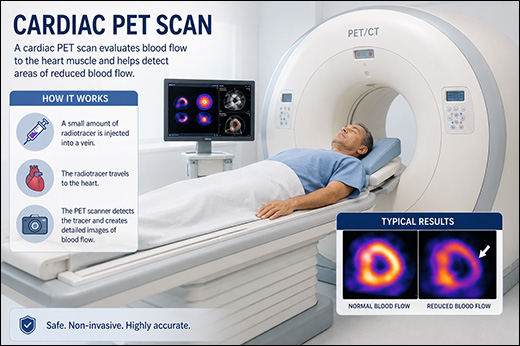
- Tracer Injection: A small amount of a radioactive tracer (radio-pharmaceutical) is injected into a vein in the arm.
- Resting Images: The patient lies on a flat table that slides into a large, doughnut-shaped scanner. The camera detects the radiation emitted by the tracer to create 3D images of the heart at rest.
- Stress Phase: To simulate exercise, a medication is often given to dilate the coronary arteries (pharmacological stress).
- Stress Images: A second set of images is taken to see how the heart handles increased demand.
- Data Processing: A computer analyzes the "rest" vs "stress" images to identify areas of low blood flow.
Key Features:
- Non-invasive: No catheters are inserted into the body.
- Short Duration: Usually completed in 1–2 hours.
- High Sensitivity: Superior at identifying multi-vessel disease compared to older scans.
Understanding Results Of Cardiac Pet Scan
- Normal: Blood flow is uniform during both rest and stress.
- Ischemia: Blood flow is normal at rest but decreases during stress, indicating a significant blockage.
- Infarct (Scar): Blood flow is absent or very low in both rest and stress images, indicating permanent damage.
- Hibernating Myocardium: Areas show low blood flow but high glucose uptake, suggesting the tissue is still alive and could recover with treatment.
Precautions Before And After The Procedure
Before
- Avoid caffeine (coffee, tea, soda, chocolate) for at least 24 hours, as it interferes with the stress medication.
- Fast for several hours as instructed by the imaging center.
- Inform the technician if you are pregnant or breastfeeding.
After
- Drink plenty of water to help flush the radioactive tracer out of your system.
- You can typically resume normal activities and diet immediately.
Why This Procedure Is Important?
A Cardiac PET scan reduces the need for "trial and error" in heart treatment. Its ability to quantify absolute blood flow, not just relative flow; makes it a life-saving tool for high-risk patients. It ensures that patients undergo invasive surgeries only when the heart tissue is proven to be salvageable.
Can Heart Health Be Supported Through Ayurveda?
Ayurveda views the heart (Hridaya) as the seat of consciousness and the root of the circulatory system. While a PET scan identifies physical blockages, Ayurveda addresses the functional and emotional imbalances that lead to them.
Ayurvedic Understanding
- Vyana Vata: Controls the rhythm and force of the heartbeat.
- Sadhaka Pitta: Manages the emotional heart and stress levels.
- Avalambaka Kapha: Provides physical lubrication and strength to the heart chambers.
Best Ayurvedic Herbs For Heart Support
- Arjuna (Terminalia arjuna): The ultimate "Hridya" herb. It strengthens the heart muscle, improves its pumping capacity, and provides a natural protective coating to the arteries.
- Guggul (Commiphora mukul): Known for its "Lekhana" (scraping) property, it helps clear plaque and balance cholesterol levels.
- Garlic (Allium sativum): A natural blood thinner that prevents clot formation and improves overall circulation.
- Turmeric (Curcuma longa): Reduces the chronic inflammation in the blood vessels that often leads to CAD.
- Ashwagandha (Withania somnifera): An adaptogen that lowers cortisol (stress hormone) to protect the heart from stress-induced damage.
- Brahmi (Bacopa monnieri): Calms the mind and balances Sadhaka Pitta, reducing the mental strain on the physical heart.
Advanced Diet And Lifestyle Protocol For Cardiovascular Vitality
To optimize heart health, Ayurveda and modern functional nutrition combine to create a "bio-individual" approach. This goes beyond basic eating; it focuses on vascular flexibility, metabolic fire, and cellular repair.
Vascular "Scraping" Foods: Incorporate Lekhana (scraping) foods that naturally clear the arterial walls. High-fiber grains like Barley (Yava) and Millets are superior to refined grains for maintaining low lipid levels.
The Hridya Superfoods
- Pomegranate (Dadima): A natural ACE inhibitor that improves arterial blood flow.
- Walnuts & Flaxseeds: Rich in Omega-3 fatty acids, essential for reducing vascular inflammation.
- A2 Ghee (Cow’s Ghee): Used as a "carrier" (Anupana) for heart herbs. Unlike processed oils, A2 Ghee contains Butyric acid, which supports a healthy gut-heart axis.
- Polyphenol Loading: Transition to a "Rainbow Diet." Dark berries and leafy greens provide the antioxidants necessary to prevent the oxidation of LDL cholesterol (the primary cause of plaque).
The "Salt Shift": Replace common table salt with Saindhava Lavana (Himalayan Pink Salt) to prevent water retention and manage blood pressure without aggravating Pitta.
Therapeutic Movement & Breathwork (Yoga & Pranayama)
Chest Expansion (Heart Opening):
- Setu Bandhasana (Bridge Pose): Stretches the thoracic cavity, improving the space for the heart and lungs to expand.
- Bhujangasana (Cobra Pose): Specifically strengthens the back muscles to prevent a "hunched" posture that compresses the heart.
Advanced Oxygenation (Pranayama):
- Anulom Vilom (Alternate Nostril Breathing): Directly balances the Sympathetic and Parasympathetic nervous systems, reducing the "fight or flight" strain on the heartbeat.
- Bhramari (Humming Bee Breath): Scientific studies show this increases Nitric Oxide production in the sinuses, a natural vasodilator that helps lower blood pressure.
- Zone 2 Cardio: Brisk walking for 30 minutes daily is treated as Vyayama (physical exercise) to enhance the Agni (metabolism) of the heart tissues.
Circadian Synchronization (Advanced Routine):
- The Brahma Muhurta Rise: Waking up 1.5 hours before sunrise aligns the body with the natural Vata peak, which promotes efficient circulation and waste elimination.
- Abhyanga (Self-Massage): Gentle daily massage with warm Sesame or Dhanwantaram oil improves lymphatic drainage and reduces the peripheral resistance that the heart must pump against.
- Mental Hygiene (Sattva-Vajaya): Yoga Nidra – A 20-minute session of guided relaxation is equivalent to 2 hours of sleep for heart repair.
- Meditation: Consistent practice reduces systemic cortisol, the "silent killer" of cardiac endurance.
- Early Supper: Finish the last meal by 7:00 PM. This prevents Ama (undigested toxins) from forming overnight, which otherwise leads to "sticky" blood and arterial congestion.
Conclusion
The integration of advanced diagnostic technology with time-honored holistic wisdom represents the pinnacle of modern cardiovascular care. A Cardiac PET Scan serves as an indispensable tool for precision medicine, providing a high-definition "viability map" that allows clinicians to distinguish between salvageable and permanently damaged heart tissue with unparalleled accuracy. While this technology excels at identifying physical blockages and blood flow deficiencies, Ayurveda offers a robust framework for long-term prevention and systemic strengthening. By utilizing potent Hridya herbs like Arjuna, adopting a vascular-cleansing diet, and synchronizing with circadian rhythms, individuals can address the root causes of arterial plaque and metabolic toxins. Ultimately, combining the diagnostic clarity of a PET scan with Ayurvedic lifestyle protocols ensures a comprehensive approach that not only treats existing heart disease but actively cultivates lifelong cardiovascular vitality.